What type of farming were the "Ginn's" doing?
Did the farms have a name? For instance, Taylor refers to 'Garrets' in his biography of William Ginn of Aston d. 1520. This farm was in excess of 200 acres. The size of the farm was considerable relative to the size of the parish, at between 2052 and 2170 acres. According to Collins, William Ginn, b. 1450, Aston, Yoeman, was a "Very wealthy man. Owned 220 acres around Aston called 'Jaretts'.
Also, "It is stated in the Parliamentary returns of 1786 that Arthur Ginn by his will dated in 1705 devised a rent-charge of 6s. 8d. for the poor, issuing out of a farm called Purvis in this parish ; also that an annuity of 10/. out of an estate in Anstey and Barkway was given by a donor unknown. This charity has not been paid for many years. The distribution to the poor was formerly made in coals" (History of hertfordshire, v4)
There is a farm named 'Garrat's' just southeast of Benington. But Benington parish is not considered part of Aston.
Here is what Dr Taylor had to say when I asked him about this:
"[T]he Ginns mostly grew corn, but they also had acres of legume veg (peas and beans) in the 1500s because stews were popular (ever had Pease Pudding ? ). Thomas Ginn mentions acres of peas in his will of 1526. There were lots of pigs (killed and cured for winter), chickens, some cows (cheese was a staple food) and a fair number of sheep. They had plough, cart and some riding horses. Animals were comparatively rare cos you had to feed them in the winter when there was no grazing. So they killed a lot and just retained a breeding stock.
A man who had a wife and kids needed a Virgate (thirty acres) of land to be self sufficient. Below that he had to labour for wages for part of the year.
The Labourer and Husbandman lived in a cottage. The labourer would have a cottage an acre or two adjoining, a cow for milk, some pigs he put on the common but otherwise it was very hard graft for wages. Some years he starved. The Husbandman would have about twenty or thirty acres, in good years he ate and had a bit over for luxuries - in bad years he had to labour part of the year for other people. He likely shared a plough team with a neighbour. The cottages were mostly one storey with a Hall (living room) and Parlour (bedroom for all of them). The cooking was done over the fire in the Hall. The cottage was open to the roof (smoke went out through a hole) but because this was not a good fire risk, by the later 1500s they are trying to squeeze in a brick chimney stack. By the 1600s they also tried to squeeze in a very tight (and low head height) second storey - you used a ladder.
The Yeoman had forty or fifty acres plus. He had some standing in his village. He wore weapons. His sons went to fight ("the Yeomen of Old England") in the armies of the King. He was a freeholder with the vote, attended jury service - tried to better himself by giving his sons good marriages and putting his sons to apprenticeships in the City of London. Yeoman lived in what they proudly called "Mansion houses" which sounds grand but mansions were rooms. Their houses were largish with Hall, Parlour, Buttery, Kitchen and Brewhouse. There was a second storey where there were chambers - the grand chamber where the yeoman and his missus would sleep if they did not use the Parlour, little chambers for the kids and the maid. It was comfort. There were four posters, coverlets, fancy chairs, chests (I own a chest from 1663 - it is a wonderful oak carved thing) cupboards (think sideboard) joined chairs (as opposed to stools) and painted cloths (wall hangings) These are mentioned in Ginn wills.
Wythams
There is only ONE Ginn Mansion House surviving that I know- that is "Wythams" which is on the Chelmsford-Harlow Road. I drive past it often.
Henry Ginn (1594-1656) of Norton Heath and High Ongar, son of Henry of Fyfield (d. 1615) lived here. It was called "Wythams" in his day too - there are deeds. Until about 1920 it was thatched. It now has a tile roof. If you look carefully you can see that the dining area (that was the Parlour) is still open to the roof. If you look even more carefully you can see Henry and his wife Frances in front of the fire. The house is worth over £1,000, 000 now".
Michael sent me these pictures:
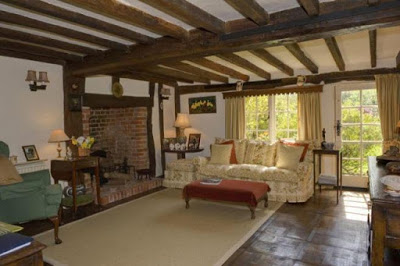
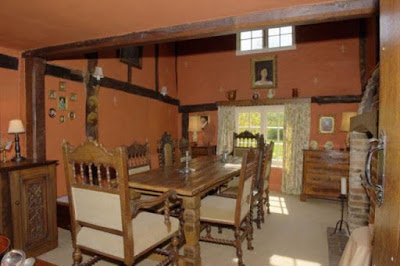
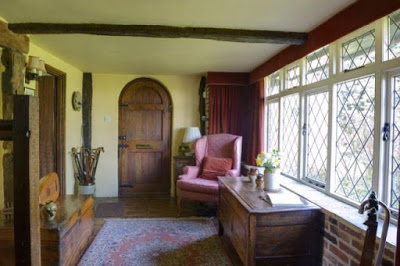
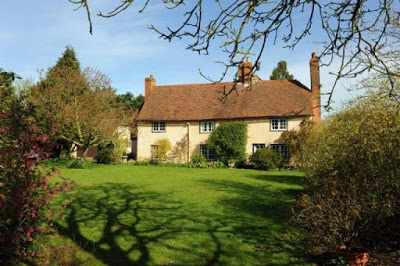
Other GINN HOUSES referenced ...
William Ginn of Aston (circa 1450-1520) was a Yeoman farmer who owned a farm/tenement called "Garretts" or "Jarretts" in Aston of about 200 acres. Michael mentions that John Ginn, who died in 1557, inherited 'Jarretts' from his father although he had to pay [his brother] William off with £10. Also, Henry (d. 1539) and Henry and Katherine's home was a farm or tenement known as "Passmers" the exact location or extent of which in Anstey (manorial records not surviving for this period) I have not been able to identify. Robert (d. 1587) and Agnes lived in 'Passmers' in Anstey
Ginn family of Hertfordshire: Benjamin Genn of Ely and Bury St Edmunds died 1691 (ginn-hertfordshire.blogspot.com)
Ginn family of Hertfordshire: Thomas Ginn of Huntingdon d. 1636 (ginn-hertfordshire.blogspot.com)
Even among the peasants, there were 'classes', so to speak. What was the status of "Ginn's" in Hertfordshire before William Ginn showed up in 1450 and if so, for how long? Were they considered yeomen, villeins, sokemen or husbandmen?
Images of medieval farming
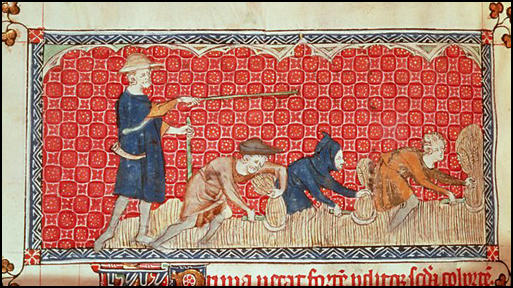
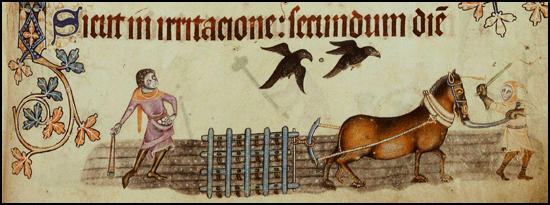
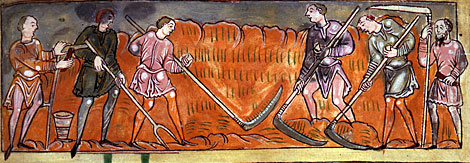
See also: produce (Pigot), on Anstey, Aston and Hertfordshire Historical Notes page.
Note: There is a lot of content written by Dr Michael Taylor about Ginn's that appears on other sites, sometimes with credit and sometimes not.