Dr Taylor states, in his study:
"The origins of the Ginn family
I am not in the business of pure speculation, but it is obvious that the Ginns were not in Hertfordshire before 1400.
It is clear that the "cradle" of the Herts. family were the adjacent parishes of Aston and Stevenage, and it is equally clear (from the incredible survival of the manorial records) that the family were not in either of them before 1420 and probably later than that.
There were a great many of this surname in Cambridgeshire and Suffolk in the 15th century, many of whom were prosperous enough to leave wills. These would probably be in Latin, but it is my ambition to one day go through them, with the hope of finding mention of Hertfordshire. It seems clear that many early Ginns were Yeomen.
My feeling, and it is only an instinct, is that William Ginn (or his father) came to Aston from another Manor held by the Abbey of Our Lady at Reading. This Abbey was a major religious house and owned extensive lands. It may have asked a tenant in Cambridgeshire to move to its holdings in Herts". (page 3)
Looking for ancestors before William Ginn (b 1450, d 1520)
Just as William is the progenitor of "most (virtually all) of the Ginn family descendants arising from Hertfordshire alive today", there is an earlier 'Gynn' man who was ancestor to all these families, or at least some of them. We have some evidence as to who he was, one Thomas Gynn, but to find this man based on BMD records is not possible because these records don't exist. In fact, as Dr Taylor has also said, "we are lucky to know as much as we do".
The earliest reference in Hertfordshire is "Richard Gynne or Ginn, 1307, Poll Tax/Lay Subsidy for Hertfordshire". (GHB) At this time, there is no known connection nor do we know his location.
Dr Taylor has said that, in Hertfordshire, there are is the "Ware" family, the "Stevenage" family and the "Aston" family and that the "Ware Ginn family might be a "far flung outpost" of the Stevenage family and thus possibly the only surviving descendants of that branch". Again, there is no known connection between them.
Our earliest known ancestor is this William of Aston (b 1450; d 1520), proven by Dr Michael Taylor. "He lived and prospered quite nicely in rural Hertfordshire. He became quite wealthy even by the standards of his day". But, he would not have been thought of as landed gentry. He was a 'Yeoman farmer' which meant he owned enough land to support himself, his family and had produce to sell. He would not have been required to work part of the year for a 'master'. It is possible that he may have been required to bear arms, as in fighting weaponry, in order to fight for the local Baron or Earl in times of conflict. This put him in a different 'class' than most ordinary folk. He also would have been required to purchase his weapons from his own money, they were not provided to him. These weapons did not come cheap. However, there is no evidence that William was ever required to use them.
Dr Taylor states: "I do not therefore know who William's father was, though it is quite likely that he was the "Thomas Jenne Snr" referred to in the Stevenage Manorial Roll of 1483. This is particularly likely given that William called his eldest son Thomas".
Recently, I have discovered a record from 1440 that reveals a 'Thomas Gyn of Aston'. Very likely this man is an ancestor of William Ginn. But we can't know this from information currently available. All we know is that he was alive in 1440, before William was born, and he was well enough situated to have a servant. (See note)
As Dr Taylor states in a recent post about a Simon Ginn of Aston (d. 1603):
"We have seen that Thomas Ginn, yeoman of Aston in the mid 1440s was the first Ginn there. It logically follows that the Aston Ginns that followed are all descended from him."
These are probably the same man. He is likely father but there is also a chance he may be grandfather, uncle or cousin. He appears to also have a connection to 'John Peryent of Digswell'. This is John Peryent the son. His father was brought to England from Gascony by Edward, the Black Prince. (See note) This is another indication that the 'Gyns' were well connected and may be further evidence of a Norman heritage.
The following is a collection of information that I have gathered up and represents what I hope is a contribution to the understanding of where we come from. No claim is being made of a connection between our family and the 'Gynes', 'Gyney', or 'de Guînes' families mentioned in this collection. It is also not the final word and more research is needed to reveal and clarify much of what is being alluded to here. What this information does do, however, is point to a number of possible clues and historical information that might be useful in further research.
Hopefully the information provided will supply a background to look into the true origin of the Ginn/Gynn family. The evidence points to a European source, most likely Normandy or Brittany but as we know that migration took place in both directions, the definition of this will never be clear.
There are quite a few connections between 'Gyn' family members and members of landed gentry families (Gill, Humberstone, Nodes, Basset, Peryent, Paston). Examples include the 'Coat of Arms' issued to George, so maybe 'Gyney' too. Other references include several marriages and certain assignments of 'Gyns' to important occupations and the Paston letters.
What it tells us is that the 'Gyns' appear to be a very well placed family and, although not gentry, since they were quite wealthy yeoman farmers in many cases, probably quite close. That was likely in the sights of George when he was awarded his shield.
As Michael Taylor has stated: "One of the things that recurs time and again in the early Ginn history is their marriage to family members, close and far. These connections enabled them to found branches of the family in what were for the time quite distant places and eventually there was a network of cousins over several counties". (Henry Ginn of Fyfield d. 1615, GHB) One important, perhaps pivotal, marriage was between John Ginn (b 1525; d 1592) and Katherine Ginn, daughter of Robert Ginn (b 1503; d 1587) who were actually second cousins. This was a practice very much frowned upon in Medieval times but in this case the taboo was set aside as the marriage cemented ownership of land important in the Ginn family at the time.
From the start, when I first undertook my genealogy studies, I was always perplexed by the fact that the 'Ginn' name or variants seemed almost to pop up in various places around England at about the same time. How did this parallel development take place? Well, it looks like it was a combination of factors that led to this fairly widespread dispersal of the name. I still don't know, for sure.
Among these factors is the movement of people between England, France, Wales and other parts of Europe over centuries. People moved to battle in wars, as well as to get away from them. People moved to acquire land and also to marry. People were also relocated to save them from natural disasters, such as floods in Flanders or The Black Death. In fact, the medieval period was a time of unprecedented change in English Society. Later on, people began to migrate to larger centres for work.
Some of these people were the nobility, or their progeny. Some of the descendants, who were dispossessed, did not retain their noble status and were merged into other classes. As 'inheritance by primogeniture' is still the accepted practice amongst noble families, this probably still happens. A fairly accurate fictional representation of this 'Lordship' is a major theme in the series 'Game of Thrones'.
Some people were simple migrants who became 'English'. As a guess, these different patterns of change probably occurred quite quickly, over two or three generations and since there were no records, the lack of knowledge of ancestry for most people beyond the living generations just happened; it was the norm. People didn't live that long, relatively speaking and also ancestral knowledge, like legends, in these times would have been passed orally. People did not keep written records until much later.
Among the literate, which probably weren't that many, gathering information would have been a challenge. So, if you weren't amongst the nobility or fortunate enough to acquire an ecclesiastical position, education probably wasn't available. Regional differences in accent, vocabulary, colloquial expressions would have also put up barriers. Did an Cockney understand a Scotsman and did a Londoner understand a Jordy boy? Bring in a bunch of Frenchmen and Flemings and this would have put up significant barriers to consistent record keeping, at least for a time. From this, it follows that there were going to be differences in the ways names were pronounced and therefore how they sounded.
Keep in mind that surnames were not commonly in use before the medieval period. Surnames evolved quickly and were not written down. They may have taken different forms depending on the speaker, the listener, the local linguistic styles, and so on. At the time at which they started to be recorded in written form, local variations of interpretation of the 'sound' of the name came into play. So what was written also depended on the interpretation of the record keeper and there were no standards.
People are quite protective of their name. It would have been the same in those days. In spite of this and accounting for the above factors, it would not be surprising for a name from a single root to take on different forms in different regions. Again, this probably happened quite quickly, within two to three generations.
The beginnings of the Ginn name
If you're like me, you want to know about where our family name came from. What information we have is scant and scattered. The Ginn name is quite rare however the name appears, in various forms widely in England, mostly in the East of England, early on after The Conquest.
Summary of Ginn name occurrences
There is a large amount of information included that provides background knowledge about where we came from. On this page, you'll find a summary of records of at least 190 'Gynn' men and a few women (or name variants) from before 1500, that is, before Henry Ginn (b 1476) moved from Aston to establish a new family at Anstey. Each one has a background note. The number of available records is limited and there is not enough data to establish any connections with anything approaching surety. Separately, there are collected names from 'Guyn', 'Gynes' and 'Gyney' and variants that seem to be relevant.
From the list of Hertfordshire men found before 1500.
The locations mentioned in this list are very close together. They are all within a sixteen mile radius of the fist name mention, a John Gyn in Welwe in 1401. Welwe is now known as Welwyn. All easily within the distance a man on his horse can ride in less than a day. None of the references include the age of the men but they are all adults. Their actual birth year might 25 or 30 years before the date of the reference. So the first two men might be only a couple of generations later than the first reference, that of Richard in 1307.
Welwyn is a village and civil parish in Hertfordshire. The parish includes the villages of Digswell and Codicote. A Norman church was built in Welwyn on the site of the Saxon church in about 1190. The manor of Lockleys, in the parish of Welwyn, passed through several hands before "[t]he overlordship is found later vested in John of Gaunt" in about 1375. He was succeeded in 1399 by his son Henry, who in the same year became king as Henry IV, and the overlordship of Lockleys with his other possessions thus came to the Crown, and the manor was subsequently held of the king. Lockleys was conveyed in 1415 to John Perient of Digswell, in whose family it descended in the same manner as Digswell. Upon the death of Thomas Perient in 1545, Lockleys was divided between his second and third daughters, Dorothy the wife of George Burgoyne, and Anne, who married Anthony Carleton. (William Page's A History of the County of Hertford) See also: Victoria History of the Counties of England series.
So, there is a John Gynne shown to be in Welwe in 1401, coinciding with overlordship passing from John of Guant and then to Henry and then to John Perient within a span of sixteen years from 1399 to 1415, the same year as The Battle of Agincourt. A 'Richard Gyn' had served in the role of archer also under John of Gaunt as well as Ralph, Lord Basset of Drayton (c. 1335 - 1390) in France in 1373. And then there are the two "William's" in Berkhamsted, one in 1355 and another in 1484 witnessing important documents. (see below)
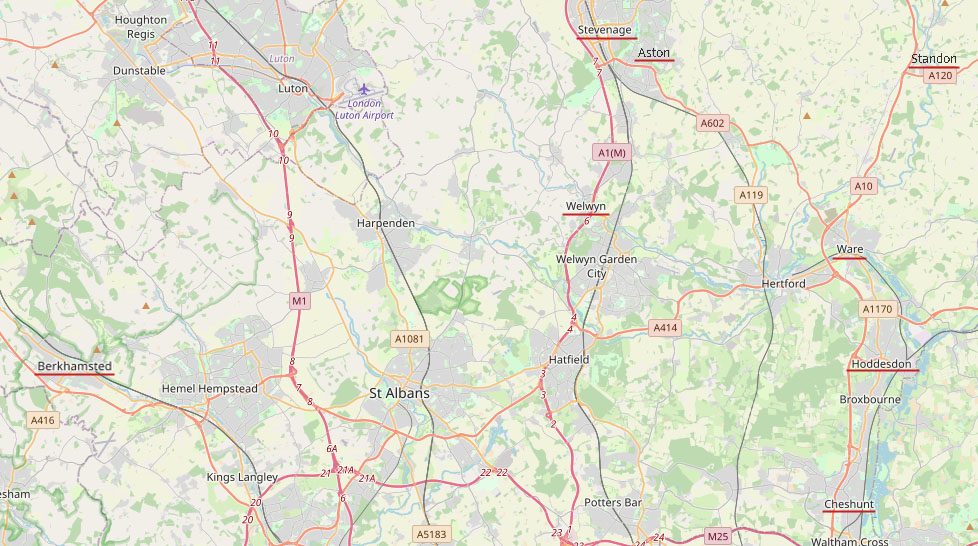
OSM Map showing Welwyn at just right of centre. Locations mentioned are underlined in red.
Then there is a William Gynn shown in 1408 but his location is unknown. The reference shows a suit against William had been brought by Richard Perers, of Chesthunt which is twelve miles southeast of Welwe. The suit also was brought against a Robert Baron of Staundon as well as a John Hyve. It is not known who these men are, however, Standon, as it is now known, is ten miles to the northeast of Welwyn. This may be as close as we get to knowing the location of this man. Standon is also where Sir Ralph Sadlier lived. Sadler had married Margaret, daughter of William Mitchell and Margaret Cromwell of Stockwell and his son, Henry's second marriage was to Ursula Gyll / Gill of Widial / Wyddial . (Mitchell notes) There is an outside chance this 'Staundon' could mean Staunton in Gloucestershire but this is over 90 miles away.
All this suggests that a relationship between Perient and Gynn went back quite far. It looks like they were important to each other. It also suggests that the marriage between John Gynn and Mary Gill was not happenstance.
It is likely there is a connection because Welwyn, Aston and Stevenage are very close together. In fact, Aston Village Hall states that "Aston is a small village in East Hertfordshire, about 2/3 miles east of the centre of Stevenage" (10) and Aston is only five miles from Welwyn.
From this list, we can also see a John Gynne in Ware in 1453 which is eight miles east of Welwe.
Not to contradict Dr Taylor but all the above men predate Thomas Gynn in Stevenage (1482), the earliest reference I have found for Stevenage. This may be simply because the record of an earlier Gynn in Stevenage hasn't been found. Then there's a 'John Gynn' in Hoddesdon in 1470 and 1472 who is shown as a 'husbandman'. Hoddesdon is about ten miles southeast of Welwyn.
Side note: There are two Gyn's mentioned in Church Mead in Essex, a John Gyn in 1417 and a Simon Gyn in 1419. There are two Church Mead's in Essex. One is now enclosed within Roydon, two miles east of Hoddesdon and the other is eight miles northeast of Chelmsford. These references are probably the latter because there are other mentions of 'Gyns' close to Chelmsford.
The Thomas Gynn, shown in Aston in 1440, also stands out as predating Thomas Gynn in Stevenage, or Ware. As stated, Aston is about five miles to the northeast of Welwe. Remember that Gynn and Perient had both hired servants with the same last name (Perot). We don't know Thomas's birth year but it was much earlier, may even be as early as 1400.
It is not unreasonable to place birth years for these men anywhere from about 1370 for John in Welwe to around 1420 for the John Gynne found in Ware or 1440 for the other John Gynne also living in Hoddesdon. It may even be possible that the John in Ware or Hoddesdon might be descended from John in Welwe. They may be the same man but alas we'll never know. And how does Thomas in Aston fit in?
Here, it is worth noting another reference to a 'William Gysne' who was witness, in 1355, to a land transaction.
In the Close Rolls of Edward III, there's a reference to a land transaction between Hugh de Ponytz and a Robert Kynebell which was witnessed by a 'William Gysne' in 1355 but it doesn't state where he was from. The likelyhood is that it is either 'Dullyngham' (Cambridgeshire) or London.
"Enrolment of release by Hugh de Poyntz, brother of Sir Nicholas de Poyntz, lord of Corymalet, to Robert Kynebell of Berkhampstead and to Christiana his wife of all his right and claim in the manor of Dullyngham, CO. Cambridge, which he had for life of the grant of the said Sir Nicholas, for 101. yearly. Hugh has also made a general release to Robert and Cristiana by this deed". (Close Rolls of Edward III; https://archive.org/details/cu31924091767941/page/188/mode/2up)
The release is dated "London, Saturday in Easter week, 29 Edward III". The reference does not show where this William was from.
So, Robert Kynebell (Kymbell) lived in Berkhampsted. Did this William Gysne, witness, also travel/move to Berkhamsted from Cambridgeshire? Was he known to John Peryent?
Berkhamsted, at the time was the site of the home of Edward, Black Prince. Edward established a centre for longbow archery at Berkhamsted. (Wikipedia)
Also, the Abbey of Our Lady at Reading held land in Berkhamsted (History of Reading Abbey by Professor Brian Kemp, emeritus, Reading University (1968), pg 50, 51)
A 'Richard Gyn' had served in the role of archer also under John of Gaunt as well as Ralph, Lord Basset of Drayton (c. 1335 - 1390) in France in 1373 but we don't know where Richard was from. (https://www.medievalsoldier.org/) So, there is the connection to Basset showing up as it has in reference to the grant of custody to William Gyn, in 1401 in Moulton, Northampton granted by Ralph de Basset of Drayton. (Inquisitions Post Mortem, Henry IV, Entries 447-509; https://www.poms.ac.uk/record/person/23116/)
Edward, The Black Prince also knew Sir John Peryent (b. 1350), having brought him from France to England. Sir John served King Richard II, King Henry IV and Henry V as well as Queen Joan of Navarre, the second wife of Henry IV. Sir John also "provided men-at-arms to Henry IV at Cirencester to suppress an armed insurrection". King Richard II was son of Edward, The Black Prince and Joan, Countess of Kent. Richard II and Henry IV were cousins, not brothers and not father and son, as one might expect. Henry IV, who was John of Gaunt's son and his son, Henry V were of the House of Lancaster, a cadet branch of the house of Plantagenet. All this made for a very messy succession. King Henry V, at age 29, was also the winning combatant at the Battle of Agincourt in 1415.
Just as in the Battle of Crécy (1346), the longbowmen at Agincourt must have played a pivotal role. A Gynn may well have been such a man, but there is no record of this that I have found.
The same page states, to corroborate the above quote from Wikipedia:
"Berkhamsted had become a centre of archery during the residency of Edward the Black Prince. It is reasonable to suppose that local men were engaged in the making and repairing of bows and arrows for mililtary use, and that they may have followed the Black Prince into battle at Crécy. The Berkhamsted Bowmen thus had a special association with the Battle of Crécy and probably played a vital role in a battle that changed the future of Western Europe".
Since the longbowmen had become such a critical function in the contemporary military structure, this must have been quite an enterprise and would have involved a considerable number of men. Did Peryent enlist men to participate in this? I think it likely that he did.
There is a good possibility that these men, having been on expedition in France with Edward, the Black Prince may have known each other. Could it be that a 'Gynn', having served in the military, was being rewarded for service and had received land or a commission to operate a farm in retirement? William Gyn, having received the grant in Northampton, might be a clue. It does seem that 'Gynns' were something of a privileged lot, at least at the time. Service to these important men may have been part of this. Also, we can't ignore the reality of the aftermath of 'The Black Plague'. The Lords would have been desperate to find men to take up working the land to supply food and wool.
We also know that Edward, The Black Prince and TWO men named ‘George Gynn' were Merchant-Taylors. A tailor would have been an important man to ensure the fit, comfort, if there can be such a thing wearing many pounds of iron, and freedom of movement in the armour in battle. How did Gynns from Hertfordshire become Merchant-Taylors? Were they tailors to Edward, or John Peryent?
In any case, one man ties all of these people together, that is Edward, The Black Prince himself. He must have been one hell of a man!
Also, is there a connection between Richard Gyn, archer and William Gysne, or Richard Gynn in the Lay Subsidy Roll in 1307, or William Ginne, innholder?
"In 1347, one Robert de Kymbell and his wife, Christiana, had been awarded a very large lease of manors, land and tenements in Berkhamsted directly from Edward, The Black Prince, long before his death in 1376. Some of this property had been passed to others by the mid 1350's with a large lease going to a 'Henry Berkhamsted' in 1358". (1)
Lastly, there was also a 'Ginne, William, of Berkhamsted, innholder, executor of; (Kymbell, Richard)'. (WAALT; CP40/890) But this was later, in 1484. Nonetheless, he had to come from somewhere. How was he related to the earlier 'William Gysne'? Weren't there other Gynns who were also innholders?
Presumably, descendants of Kymbell still held land there in the late 15th century. Berkhamsted is sixteen miles southwest of Welwe. The real question here is what is the connection between William Ginne and Richard Kymbell.
For more about William Ginne and Richard Kymbell, see 'Backstory'.
Too many ‘co-incidences' but the existence of these men is not speculation. Proving any connection will be difficult. Even if it can't be proven, it forms a compelling outline. There must be a hell of a story somewhere in all of this, a sort of 'Game of Bows'.
Background files referenced: These pages are a complete read out of the background text files in each folder and show the names highlighted in red in an attempt to expose connections that might exist. These files provide a record of a name, a date and a place but no relationships to other people. There do appear to be some possible connections but to prove them will be difficult, if not impossible. Some of these are simple coincidences but many coincidences may eventually form a pattern and that's what we're looking to find.
- Gyn Background Files (before 1500) + folder with text files
- Hertfordshire Notes (before 1500)
- Gyn Background Files (after 1500) + folder with text files
No known relationship: Information found while I was researching 'Gynn' name.
- Guyn Background Files + folder with text files
- Gynes Background Files + folder with text files
- Gyney Background Files + folder with text files
Notes
1. Register of Edward, the Black prince, preserved in the Public record office ... v.4, pg 550 Re: Grant to Henry de Berkhamsted; https://babel.hathitrust.org/cgi/pt?id=inu.32000000340044&view=1up&seq=558
2. The Household and Military Retinue of Edward the Black Prince (Doctoral thesis by David S. Green); https://eprints.nottingham.ac.uk/10912/2/298952_VOL2.pdf
See: Ralph Lord Basset of Drayton, pg 12; Henry Berkhamsted, pg 15; Peryent not mentioned.
Key Information sources
Except for nobility, there are no primary source BMD records for the medieval period. So, information about people before this time would only refer to events such as land transactions, wills, disputes and the like. Except for wills, information about family relationships is not usually found. The background files included are found from many of these sources but it is possible that new information might become available as time moves on.
Some key sources include:
(The) Harleian Society
The Harleian Society is a registered charity, established in 1869 and incorporated in 1902*. Its official objects are "the transcribing, printing and publishing of the heraldic visitations of counties, parish registers or any manuscripts relating to genealogy, family history and heraldry".
HathiTrust: Great Britain Genealogy: Search results from the HathiTrust biblographic catalog.
- Collectanea topographica et genealogica - HathiTrust
(The) Heraldry Society (UK)
- The Heraldry Society: Image Library
Hertfordshire Resources
- Hertfordshire Archives and Local Studies, Hertfordshire County Council
- Hertfordshire Genealogy
- Herts Memories: Anstey
(The) Institute of Heraldic and Genealogical Studies (IHGS) (UK)
Looking for a person? (National Archives UK)
Mapping the Medieval Countryside
Mapping the Medieval Countryside is a major research project dedicated to creating a digital edition of the medieval English inquisitions post mortem (IPMs) from c. 1236 to 1509.
Medieval and early modern family history (National Archives UK)
Medieval Genealogy (UK) (*)
Mel Locki (Some useful links)
Middle English Compendium (U Michigan)
Norfolk Record Office - Online Catalogue
The Online Books Page by Great Britain Public Record Office @ U Pennsylvania
(The) National Archives (UK)
Public Record Office (Wikipedia)
- Calendar of the Patent Rolls Preserved in the Public Record Office, Hathi Trust
- Great Britain Public Record Office: The Online Books Page
- Records preserved in the Public Record Office
- Calendar of the Close Rolls
- Calendar of the Fine rolls
- Calendar of the Patent Rolls Preserved in the Public Record Office by Great Britain
- Feet of Fine Rolls
- Fine Rolls of Henry III Project
- Pipe Rolls
WAALT
WAALT: the Wiki for the Anglo-American Legal Tradition Website WAALT is a project of the Anglo-American Legal Tradition (AALT) website of the University of Houston.
Problems and issues with exploring Ginn history before William (b 1450, d 1520)
Six hundred years ago, there were very few records. What records there are refer mostly to land claims, disputes or tax records and only include name mentions and very little else; no birth, death or marriage records are available before about mid 16th century. No way to puzzle out connections that might exist.
In those days, families did not keep records about ancestors, except for baronage, nobility and royalty.
The most important records that we know of are wills. Many exist and if you can read Medieval English they can be a valuable source of descendancy but almost never refer to any ancestors. Dr Taylor has read many wills and the information he has gleaned has added enormously to the family history.
Clearly, as we have seen, the spelling of the name also varied quite widely so tracing becomes problematic, even if records exist. People may be related but the spelling of the name in the record presents a barrier to closing any gaps.
The Black Death: On the one hand, because it wiped out 1/3 to 1/2 of the population in the mid 1300s, many lines may have died out. However, the vacuum it left, in terms of social and economic structure opened many opportunities for people to take hold of. We can only know about the survivors since records of the dead do not exist; there were no records of mass burials.
"The Black Death was a bubonic plague pandemic occurring in Afro-Eurasia from 1346 to 1353. It is the most fatal pandemic recorded in human history, causing the death of 75-200 million people in Eurasia and North Africa, peaking in Europe from 1347 to 1351." (Wikipedia)