November 2024
Presenting the latest version of what I know about our Ginn family history. This is the most important and complete information, as far as I know, about our genealogy. Also included is a copious amount of notes and background information intended to supply more depth to what we know. This is, at least in part, the story of how I - we - got here.
This will provide quite a complete overview of our known male direct family history after William Ginn of Aston (b. 1450, d.1520). There is no doubt that we are descended from this man.
An earlier known ancestral female line goes back from the marriage of John Ginn to Mary Gill which took place in 1661/2. The first known progenitor of this line, and ancestor of Mary Gill, is one 'Sir John Perient', born about 1350. We know about him because he was an aristocrat, and an important soldier in his day. He became a landholder in Hertfordshire, very near to where our Ginn ancestors lived. Aristocratic families tended to keep excellent records concerning their genealogy. This is a history that spans 675 years. Mary Gill came from a landed gentry family.
We owe an enormous debt of gratitude to Dr Michael Taylor who continues to work on his Ginn Hertfordshire Blog as new information about the past becomes available. This blog also connects our ancestors to many historical events and personalities of their day. Surprisingly, we are still learning new things about the past and this will gradually lead to a new understanding of it.
It is important to note that because of Dr Taylor's research, our's is the first generation to have knowledge of these facts since the time when they occurred, up to nearly seven hundred years ago. Previous generations of historians and genealogists simply did not have this amount of 'Ginn' family history, gleaned from 'primary' records, to draw on. I didn't have this when I started out in the early 80s.
Even more important, as Dr Taylor says: "These are real people to me". The people shown here once lived; were fathers, brothers and sons, mothers, sisters and daughters. They worked to support themselves and lived, were married, had children and died in their communities, just like us. So, the purpose of this study is also to bring life to people who are now no longer with us.
Genealogy is, in large part, a giant leap of faith. The fact that we can pull our own history from records that were kept by any of a disparate group of individuals, churches and official sources, over many centuries is, to say the least, remarkable. Early on, they are usually parish records kept by local parish vicars, priests or anyone else who may have been well enough educated to know how to write. During the reign of Henry VIII, it was Thomas Cromwell who, in 1538, made it mandatory for churches to keep records and after 1 July 1837, all certificates of births, marriages and deaths in England and Wales are kept at the General Register Office (GRO). These are the official records and are the most reliable source.
They were kept by government officials, sometimes by military and others such as census takers (who generally had a very short time to return their results. Even though no geneaologist would be looking at them any time soon, government wonks would be mashing them up for decades to study social and economic conditions).
These records have been kept in a wide variety of conditions and places. They have been thrown down wells, kept in caves and barns, been bombed and burned by invading armies, frozen, water damaged, sunk to the bottom of the ocean and impaired in any other way imaginable. Certainly, the people writing all this stuff down had no idea that anytime four or five hundered years later, people would be interested. In fact, many valuable records have been lost because the keepers needed the room for something else.
They were recorded in the handwriting of the time and pulling the information from them is sometimes like pulling teeth, as anyone knows who has done these searches. Often searches lead to nothing and many hours are spent on the wrong path ending nowhere. But other days can bear fruit, and sometimes lots of it, with hardly any effort at all. Something remarkable happens, though, when you see your own name fly out of the page, like it's alive. You will almost always recognize it instantly, even against the backdrop of barely legible handwriting on dark microfilmed copies.
So a critical eye is always necessary when viewing the results of any genealogical study but, like most things, it is valid, given the tools and resources of the time, until someone proves it wrong or reveals new discoveries that shed new light on old history. The original records preserved by the LDS church, such as parish registers, are reliable but unfortunately, subject to substantial mis-use due to the church's policy of requiring members to "prove" their ancestry. As a result, the family genealogies kept there need to be looked over very carefully.
I also caution against anyone who claims to have a "family crest or emblem". Only a very small part of European people, aristocrats, landowners or royalty ever had one or ever needed one. Most of them are fakes. Put it this way, if your family ever had it's own heraldry, you would have learned about it FROM your ancestors and not some outside source. I have discovered at least four different Ginn "coats of arms". The 'College of Arms' expressly states that there is no such thing as a family coat of arms.
There is, however, one shield that is genuine, belonging to George Ginn, Merchant-Taylor which was later claimed by a John Cook, of Giggleswyke in Yorkshire whom his wife, Jane, married after his death.
Spelling variations of this family name include: Gen, Gene, Genn, Genne, Ghin, Gin, Ginn, Ginne, Gyn, Gyne, Gynn, Gynne, Jenn and many more including: Gwynne, Gwin, Gwine, Gwinn, Gwinne, Gwyn, Gwynn and possibly others. Anyone care to guess if they're related? Some of the variants are likely the result of bad hand-writing, mis-heard pronunciation, copied from one person to another, interpretation and who knows what else.
In 2007, there are around 20,000 Ginns worldwide having emigrated from England and Ireland for lack of land enough to feed one's family or any of the other reasons people leave to seek their fame and fortune. It's anyone's guess what would push someone to leave family and home to board a small ship, at considerable expense even in those days, and sail across the ocean to parts and people unknown.
Most Ginns, as you might expect, are found in the United States (17,000), England (1,300), Canada (1,300) and Australia (700) with a scattering in other places. If you journey back to 1881, in England, there were only 836, recorded in the census of that year, and most of these were in Cambridgeshire, Hertfordshire, Bedfordshire, and so on - in the midlands, in other words. There were none recorded in the Republic of Ireland and only a few in Northern Ireland.
Ginns have been entrepreneurs in the world too, Steve Ginn was the head of Airtouch, a multi-billion dollar cellphone company, before it was bought by Vodaphone. There are resort and real-estate developers Bobby Ginn and Thomas Ginn. This Ginn Family have designed and built many resorts in Florida and elsewhere. Bobby was also to build 'Ginn sur Mer', a major resort on Grand Bahama Island but it was never built.
Perhaps the most famous is that of well known Ginn Publishing Co, started by Edwin Ginn (son of James and Sarah Blood Ginn), born in Orland, Maine in 1838, and his brother, in Boston, Massachusetts (no relation has been found yet). There are Ginn artists, scientists, professional golfers and many other walks of life.
Ginn's have also been sports figures (Matt Ginn, NHL; Ted Ginn Jr*., NFL) and musicians. (Greg Ginn, Landon Ginn) and Peter Ginn, a well-known BBC presenter appeared in several documentary series.
* There's something about Ted Ginn Jr that surely stands out, he's Black. Now anyone has the right to question why there are Black Ginn's. It must be that, at one time, there were Ginn's who were slave owners. These people inherited their master's name and their descendants carry it to this day. His father, Ted Ginn Sr, a winning football coach with a strong community spirit, was born in Louisiana, in the American South where most Black Ginns are found today. Dr Taylor discusses Arthur Ginn, the first known Ginn in America. It is likely that many American Ginns are descended from Arthur.
Historically, surnames evolved as a way to sort people into groups - by occupation, place of origin, clan affiliation, patronage, parentage, adoption, and even physical characteristics (like red hair). Many of the modern surnames in the dictionary can be traced back to Britain and Ireland. (1)
Surnames are also related to places: "A toponymic surname or topographic surname is a surname derived from a place name". (2)
See separate document about the beginnings of the Ginn name.
This is the earliest 'Ginn' history that I was able to establish from the records. Again, the credit for the records of our ancestors goes to Dr Michael Taylor who has been instrumental in gathering and documenting individuals both in our direct line as well as related persons. See Michael's 'one-name study' on the Ginn name in his Ginn Hertfordshire Blog. To clarify what is meant by a 'one-name study': It is a study of individuals bearing the same name, in this case 'Ginn', and is not the same as a genealogy. However, one can certainly glean genealogical facts from the information.
William Ginn of Aston (b. 1450, d.1520)
William is our oldest known direct ancestor along the male Ginn line. He was born in 1450 in Aston, Hertfordshire, and died there in 1520. It is thought that his father was one 'Thomas Jenne, snr' but there is no actual record to confirm this.
Recently, I have discovered a record from 1440 that reveals a 'Thomas Gyn of Aston'. Very likely this man is an ancestor of William Ginn. But we can't know this from information currently available. All we know is that he was alive in 1440, before William was born, and he was well enough situated to have a servant. (See note) This may be the same man but this can't be confirmed.
As Dr Taylor states in a recent post about a Simon Ginn of Aston (d. 1603):
"We have seen that Thomas Ginn, yeoman of Aston in the mid 1440s was the first Ginn there. It logically follows that the Aston Ginns that followed are all descended from him."
Many of the early Ginn men were known as 'Yeomen farmers'. Quite a few of them had become quite wealthy in their enterprises, especially landholdings. So, for example, the farm held by William (and several descendants) was known as 'Jarrets'. It was near Aston in the western part of Hertfordshire and included around 220 acres, so quite a sizable holding.
His son, Henry, is next in the direct male line. Henry moved to Anstey in eastern Hertfordshire, establishing farmstead and family there.
See: Ginn Hertfordshire Blog Menu for the complete list.
A grandson of William, one Robert, had decided to move into Huntingdon and established an allied line there. He became quite an important landholder there. He may be one example of farmers, or landholders, who capitilised on the disruption of landholder lineages that resulted from 'The Black Plague'. Robert had a son, Thomas, who became a prominent citizen in Huntingdon including being on the town council. This Thomas was in the Company of Sir Oliver Cromwell but it is clear he knew Cromwell before because he also supported his entry into Parliament. So, it is clear that he did carry some influence and is referred to as a 'gentleman'.
Most of the men, starting at about age 15, worked as farm labourers. The women and children worked as "straw plaiters", an intricate process of weaving straw. This industry flourished in the midlands where, at one time 80% of the British workers in the hat trade worked in this region, where a well made 'split' straw hat could earn a fairly pretty penny. Weekly plait markets drew up to thousands of people. This industry continued until up to the 1920s. Some also were dressmakers and lacemakers as all of this work was done by hand until somebody figured out that a machine could do this work. Potton also had a lively produce market from an early date.
It is key to bear in mind that the establishment of the landholdings of these Ginn men closely followed on the heels of 'The Black Plague' which in the late 14th century had taken out a significant portion of the population. Many areas were desparate to re-establish farmers who were able to take the land and produce food and other goods, especially wool. We see that Ginn's were fairly well situated to take up this task.
However, Ginn's never did become 'landed gentry' despite significant landholdings and relationships to numerous prominent families.
Learn more about: A day in the life in the 1600s.
(See also: Donna Bailey @ Geneanet . Donna is the daughter of David Victor Bailey and the granddaughter of Victor Charles Bailey, Born 8 June 1916 - Coldstream, NSW, Australia. Sadly, there were some errors in Ms Bailey's transcription of Michael's data. This has no impact on our direct line but certain individuals in related lines need to be looked at carefully.)
The last man in Dr Taylor's blog who is in our direct line is one 'Joseph Ginn of Potton, Bedfordshire (d. 1807)'. His 'Updated Ginn Study' does include descendants Thomas (b 1786; Family Sheet 373), Joseph (b 1812; Family Sheet 378) and John (b 1849; Family Sheet 386).
Briefly, Joseph and his wife, Jane (Game) had a son, Thomas, who married Mary Surkett in Cardington in 1808 and had a son, also named Joseph, who was also born in Potton, on Mar 30, 1812, married Elizabeth Liles in Marylebone in 1838 (See note) and lived in Potton but eventually moved to Finchley. Reason for the move is unknown but most likely was to find work. This is where my Great-grandfather, John, who married Martha Cullip in Bedford in 1875, was born. It may be helpful to look at the Ginn Hertfordshire Blog Menu to get a better sense of the Ginn lineage up to this point.
For anyone interested, I have collected some information pertaining to 'Early Ginn's in Hertfordshire, 2021. These people may be our ancestors but there is no way to know. Thomas Gyn, 1440, Aston very likely is an ancestor of William (b 1450, d 1520).
From here, the following are not part of Dr Taylor's study:
Where I started
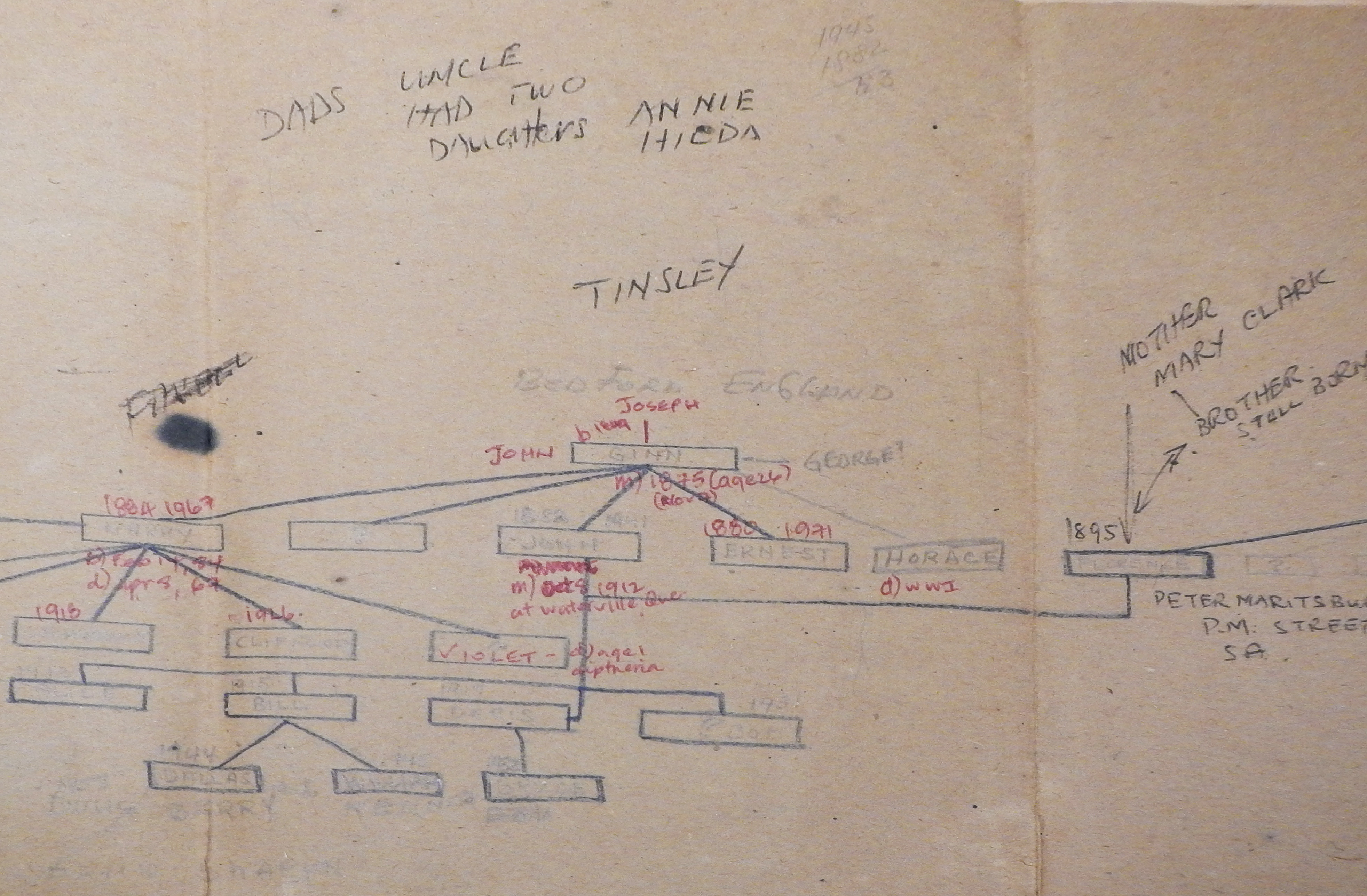
Part of the notes Dad had started, to show what he knew about his family.
His notes are in black ink and pencil and he had worked out a rough descendancy shown by the blue frames.
I added to them (red ink) after Dad died when I was discussing the family history with Aunt Alice, Dad's sister.
As I recollect, I had taken dad's information and managed to find the connections back to Thomas Ginn, b 1682 in Anstey before discovering Dr Taylor and his work. It was quite gratifying to learn that I had made these connections on my own and that they were accurate. Genealogy is a process of moving from what you know to discover what you don't know.
This Thomas definitely raised a family which included John, my Great-grandfather (born 1849, Finchley. I don’t have a date) (1851, 1861, 1871 Census records). Thomas's father, Joseph, died in 1878.
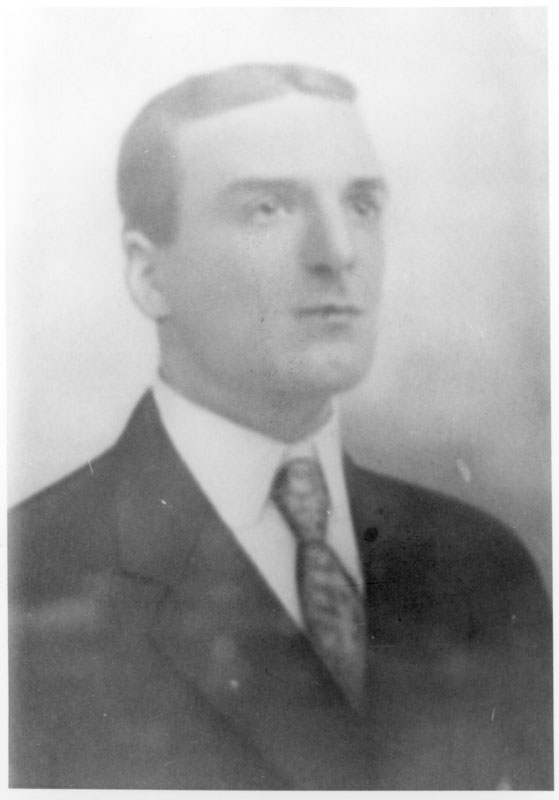
I believe this is John Ginn (b. 1849), my Great-Grandfather but I cannot be 100% certain.
John Ginn (GGF) married Martha Cullip, the daughter of Thomas Cullip and Elizabeth Ann Barker, at Bedford, Holy Trinity Anglican Church on Nov 7, 1875.
John and Martha had a son: John William, my Grandfather, who indeed had 4 brothers: Arthur Thomas, Ernest, Horace Edward and Harry Charles. They were all born at Bedford.
The family apparently moved to Bedford after the death of Joseph and lived at # 3 Ampthill St, known as "The Goat's Inn" according to census information. They later lived at # 5 Ampthill, presumably after Joseph had died. They had lodgers at this address including one Charles Lodovick who is probably related to the wife of Thomas, John's brother. There was also a sister to John, a 'Fanny Jane' born in 1854.
The family in Bedford includes the aforementioned Elizabeth (Liles) having been born in Potton and who, by this time, is shown as being 54 years old. (1881 census) There is some confusion about her age since someone had given erroneous information to census takers. This problem concerning errors in census information is quite common.
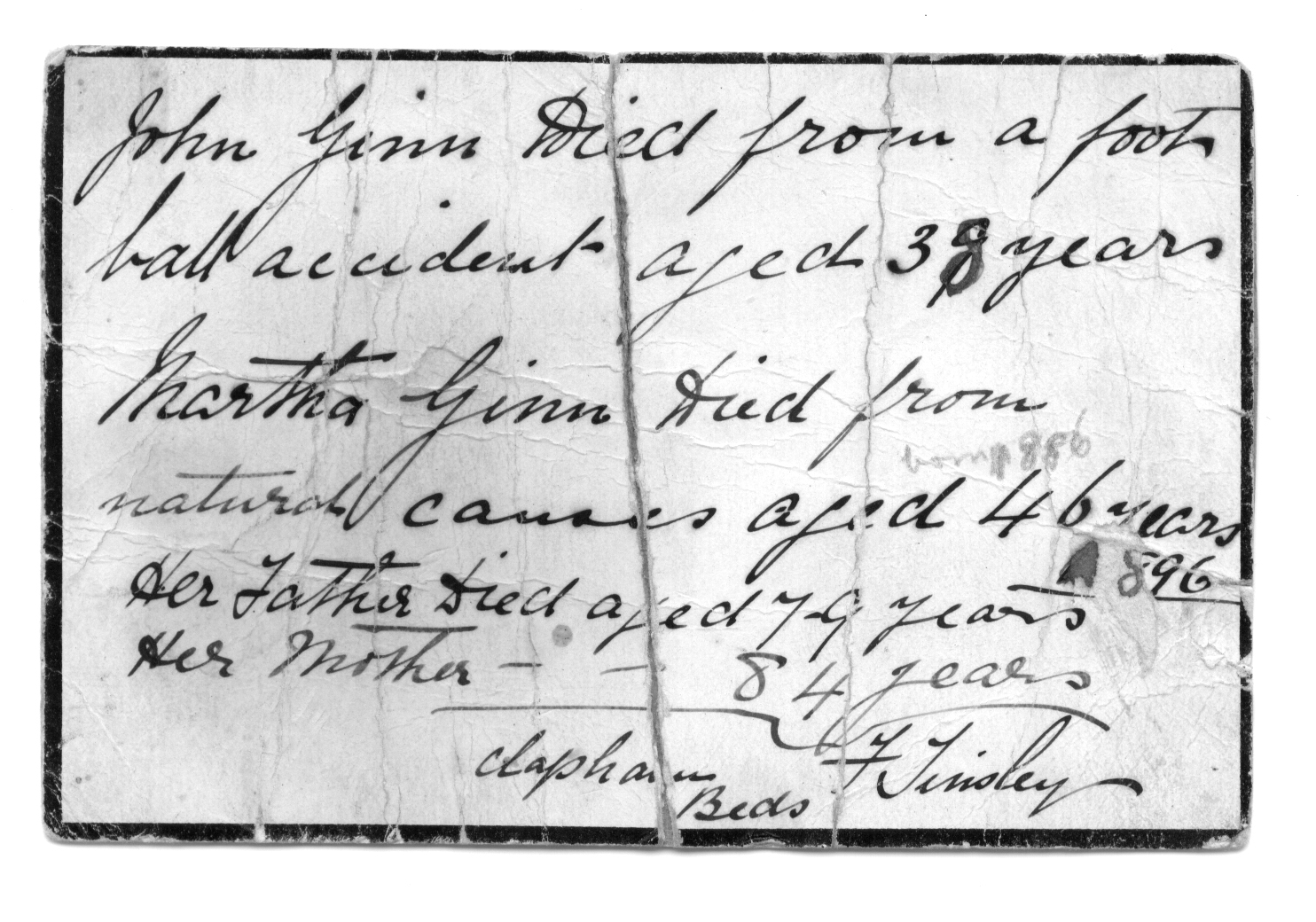
An undated card, written by F Tinsley, with some notes about John and Martha Ginn, my Great-Grandparents.
It was most likely written before my Grandfather came to Canada. Fred Tinsley was Martha's Brother-in-law.
As the card says, John died in about 1887, 'from a football accident' and from there, the family broke up. Ernest & Harry ended up in the Ottawa area in around 1910 while John William had originally emigrated to Capleton, Quebec. Ernest & Harry lived for a time on Dolly Varden St, now known as Plymouth St.
Horace Edward of the Bedfordshire Regiment, 1st Bn was killed in action, likely in The Battle of La Basse, Armentières and Messines in France, WW1, on Oct 31, 1914 at the age of 38, just after the war began. I have his Memorial Plaque, aka 'Dead Man's Penny'. I don't know the fate of Arthur Thomas.
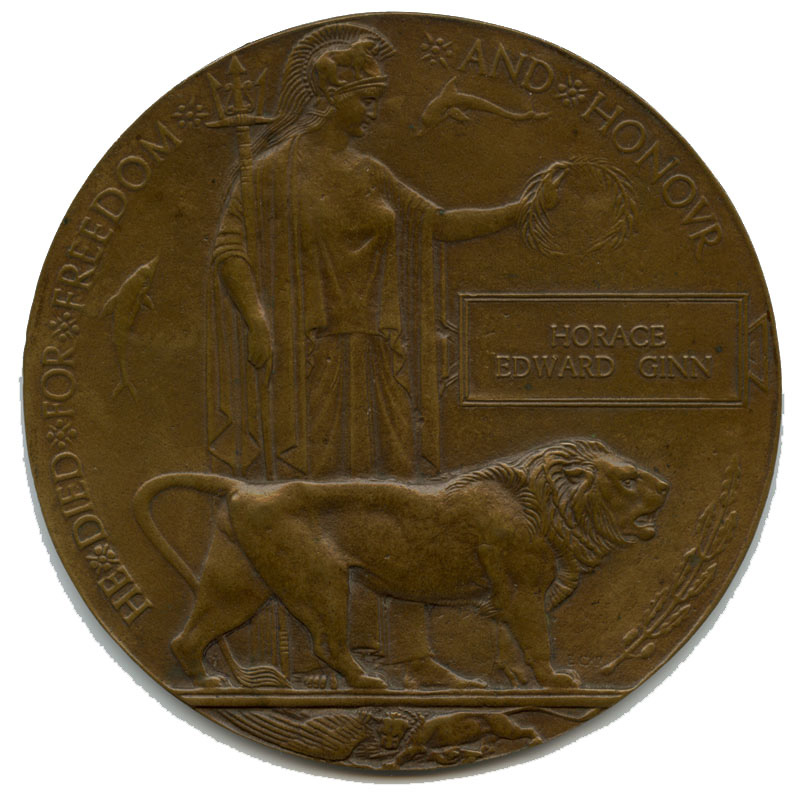
The Memorial Plaque honouring Horace Edward Ginn. It is about 4-3/4" in diameter.
Joseph and Elizabeth had other sons - Alfred, Benjamin and they raised families there. A third son, George had also remained in Finchley and raised his family there. Eventually, George also emigrated to Canada, sometime before 1921, because we can find him in the Canadian Census of that year along with his wife Amelia and son, Samuel. Another son of George, one Rowland, aka Roy, had come here a bit earlier, in around 1910. They lived in the Montreal area.
A fourth son, Thomas married Mary Ann Lodovick and moved to Bedford. It is very likely that this family subsequently broke up as a Thomas Ginn (b 1842), along with his son Thomas (b 1876) were living in Algoma District (Sault-Ste-Marie) Ontario in 1911 where the younger Thomas was married to Janie (or Jennie) Lavelle. Mary was still in Bedford in the 1901 census. The six other surviving children of Thomas and Mary were all girls. Two other children died in infancy. The elder Thomas is my Great-Grandfather's brother.
Please note that a history that was done (by a professional genealogist) for Leonard Ginn ( a cousin of my dad) indicating that the John who is Ernest’s (and therefore John William’s father) was born in Wrestlingworth in 1853 but this is not correct.
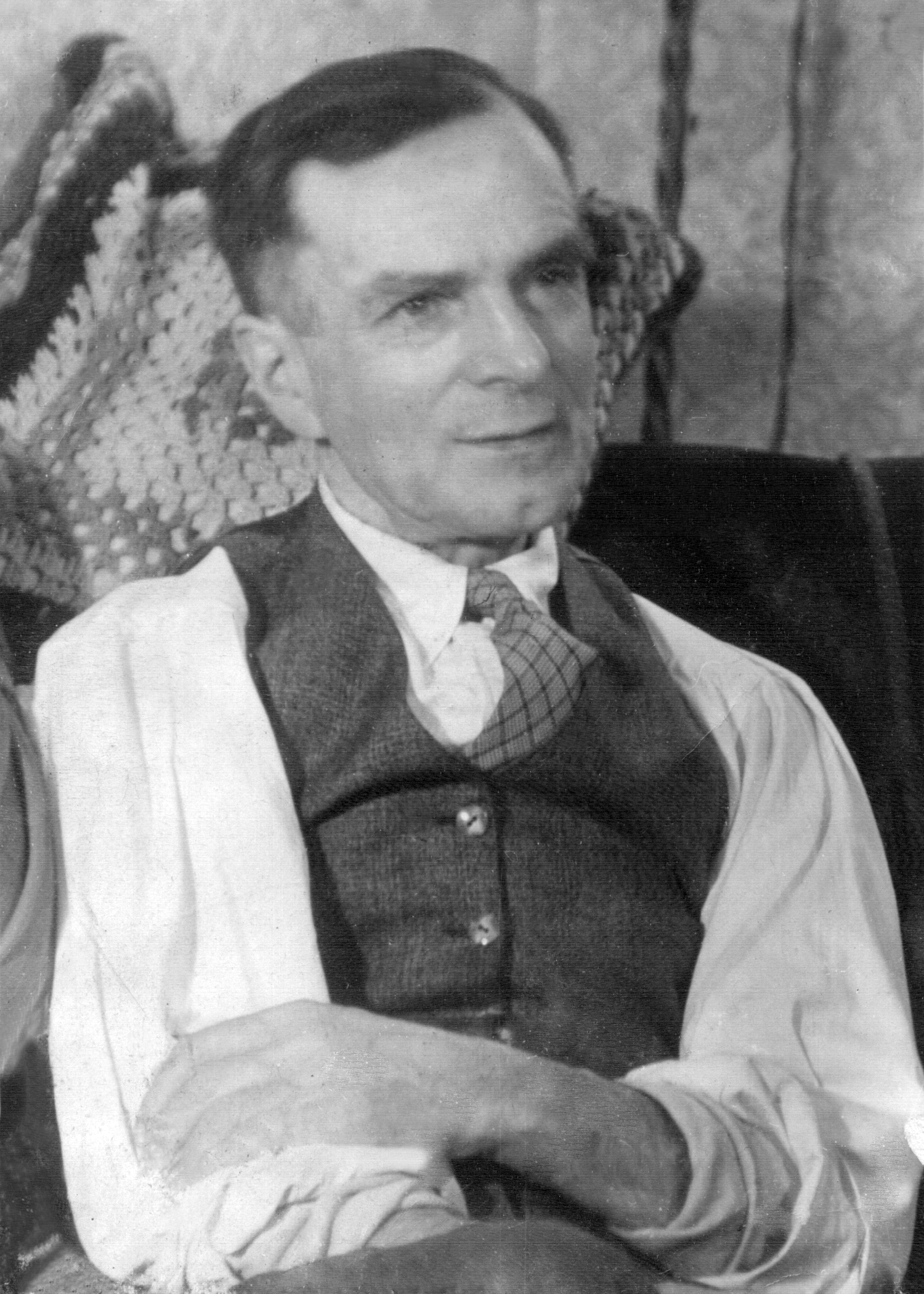
John William Ginn, my Grandfather (Undated) Photo probably taken by my Father.
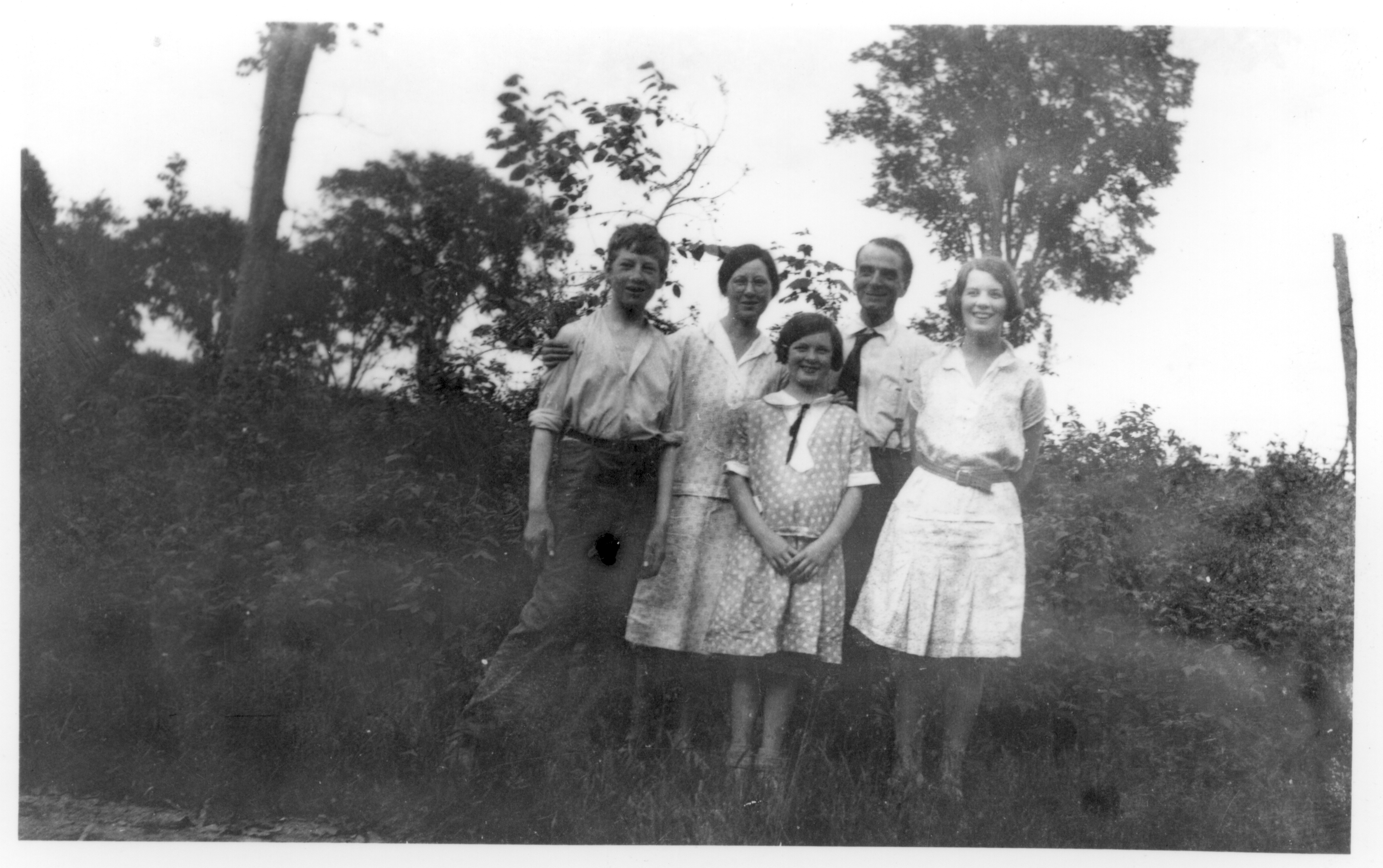
John William and Florence Ginn with children; William Ernest, Alice Lilian and Dorothy Hilda (youngest). Photo taken about 1929.
William Ernest (Bill), my father, is the son of John William Ginn who emigrated originally to Capleton (Sherbrooke) in Quebec where he worked for the Nichols Chemical Co. as a "chemical tester". There he met Florence Ethel Eccles, daughter of Harry Eccles and Mary Clark, who had emigrated together with her widowed Aunt Alice Renshaw, a dressmaker from Sheffield, Yorkshire. Aunt Alice was known to have made clothing for the students at Bishop's College.
Legend was that Florence herself had been returned to England in 1901 from South Africa where she was born in 1895, as baggage complete with tag, after both her parents had been 'killed by the Boers in 1900'*. (* Note: This was 'family legend' and the killing actually didn't happen. While researching 'Harry Eccles' in South Africa, I have found evidence that shows a 'Harry Eccles' being discharged from the British Army in 1895, just after Florence's birth. He went on to join a local militia in SA known as the 'Natal Royal Rifles', based in Estcourt where he lived at the time. On this page, he is there, as a Private, #238, and served from 30 September, 1899 to 31 May, 1902. It is more likely that Florence, who was only six, was sent in 'steerage' class but she was probably unaccompanied.).
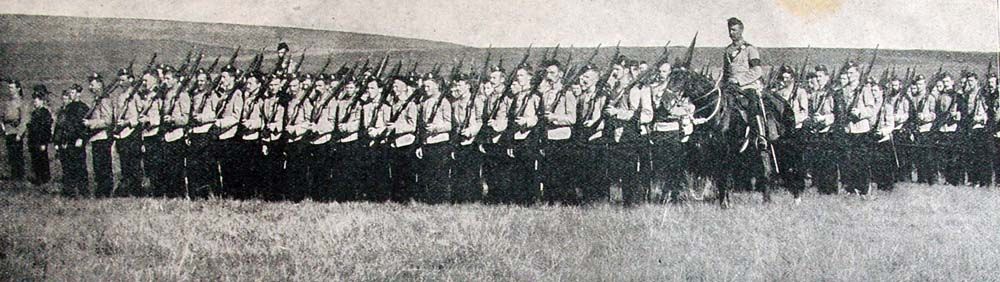
The Natal Royal Rifles
"In 1900, for seven months this force, or portions of it, had done good work in protecting the north-east of Natal from invasion or raids".
His military record shows that 'Harry' was of small stature, standing 5', 4" and was also a painter. 'Harry Eccles' survived his second call of duty and married Georgina Harris in 1901 with his subsequent death in 1903 at the age of 36. There is no record, that I have found, of a marriage to Mary Clark, or McAloon but Florence's birth certificate shows Mary is her mother, so maybe this was a common-law marriage. It is said she had a brother who died and was buried at sea but I can't confirm this. My father's notes state that Florence's brother was 'stillborn'. Florence can be found, together with Aunt Alice Renshaw in the 1901 UK census in Yorkshire. I have found no evidence of what happened to Mary Clark.
John William and Florence were married at St John's Anglican Church in Waterville, Quebec on Oct 8, 1912. He hadn't wasted any time, having immigrated only in 1911, but if you see pictures of Florence at this age (17), she was beautiful. In fact, she retained her natural beauty until she died at age 80. John was apparently a cat-lover, as recollected by my aunt Doris.
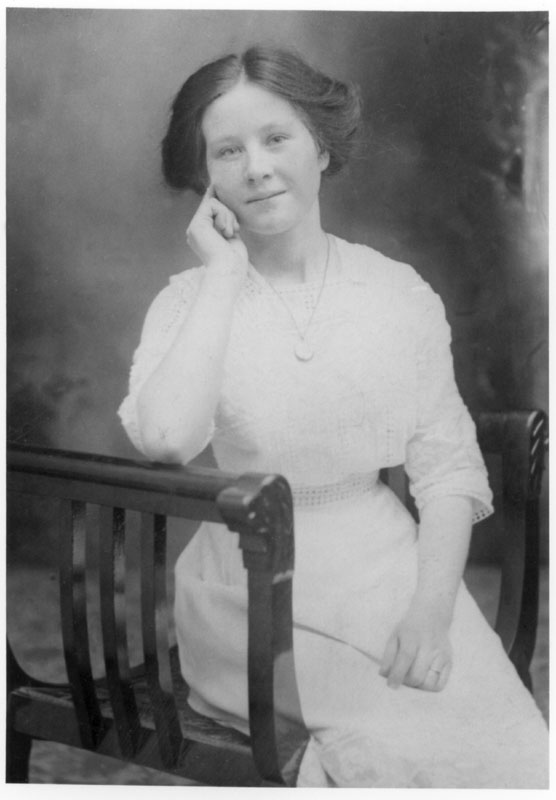
Florence (Eccles) Ginn as a Young Woman. (Undated; It may be her wedding day, she is wearing a ring. If so, she is just 17.)
My grandfather had loaned some money to one of his brothers at some point but the money was never repaid. This formed a rift between them, which was never healed. From that point, brothers Ernest and Harry chose to pronounce their name with a soft 'G', as in 'gin'. My grandfather continued to use the hard 'G'. From my studies, the soft 'G' was the pronunciation most common in England.
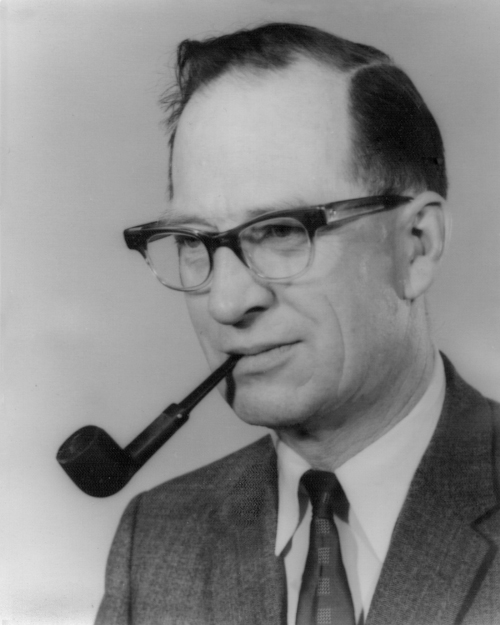
William Ernest Ginn (1915 - 1975); Photo taken about 1965.
William Ernest (Bill), was born June 15, 1915 in Capleton, the second of three children born to this couple. He had started to gather family information which he had recorded on a plain piece of paper, in his own handwriting. This showed immediate family, as much as he knew, but had some general information about Bedfordshire, from where my grandfather (John William) emigrated, along with two brothers (Ernest and Harry), to come to Canada. This became the basis for my venture into discovering our ancestors. There was also a few clues on the small card where Fred Tinsley had made some notes about what he knew.
My Grandmother, Florence, had also made some notes about her children and I'll relate them here: "Alice Ginn, 3lb baby could not dress her. Rolled in cotton batten & Olive oil put in a basket on oven door for 3 months, shortened at 7 months put her thumb in her mouth when born and covered with fat. Bill weight 8-1/2 lbs born an hour before we could get a doctor 14 miles from any doctors. Born at night after supper. Doris weighed 5 lb & born about midnight. Hair like silk & black & 1 in long. Robert's hair blond, a lovely baby so good 8-1/2 lbs."
They stayed in Capleton until about 1921 when the Nichol's factory burned to the ground. That's when they moved to Ottawa. While in Ottawa, John William worked as a bus painter for the Gatineau Bus Lines and also as a fireman for the CNR as well as for the Colonial Coach Lines, although I don't know what his job was there. He died, in Ottawa, at age 59, in 1941, after a "5 year illness", any wonder given the jobs he worked at. I don't think they had even heard of health/safety standards in those days. (Note: I have found no record of John William Ginn or this family in the 1921 Census of Canada. It is possible they had moved away from Capleton and had not yet arrived in Ottawa. Their whereabouts during this time remain a mystery.)
Although raised as their own child, Robert (aka Bob) was actually the son of Leslie, a cousin of my grand-dad. He was much younger, being born in 1931. Leslie and Elsie had seven children, eight if Robert is included. They were unable to care for them properly. So Robert was raised by John and Florence. At some point, Leslie and Elsie wanted Robert to be returned to them but Robert refused, now that he had accepted his adoptive family. He was seriously injured sometime during WW2 when, at the age of about 11 or 12 years, he was playing in the train yards along the Rideau Canal. He picked up a hand grenade and pulled the pin. He lost part of his right arm and one eye. This, however didn't slow him down. Robert had an artistic talent and learned to paint with his left hand. He was also an accomplished draftsman and worked for the federal government in this role.
I remember my father said that he had carried his father down the stairs after he died and he only weighed about 90 lbs. The wake was held in their living room as was a fairly common practice at one time. It was right after this that he went to England and was stationed at Victoria Station in London during WW2 and lived at #10, Bessborough Mews. He had been granted permission to marry Joan Gladstone Young on or after, 9 Sep 1945. They already had a daughter, Dallas Georgina but Joan died in childbirth along with their second child, a boy, in 1945. She needed blood transfusions but there was no blood owing to the war.
My father worked at several jobs during his early years, as a mechanic, in a furniture factory with an unspecified job in 'radio'. He enlisted three times, once in 1930, in the Signal Corps, where he worked as a driver/chauffeur and then with the permanent force in 1937. He re-enlisted after WW2 and retired, as a Sergeant, in 1960.
He served in Canada, the UK and the US where he worked in Army Service Corps, Troop Movements. He had attained the rank of Sergeant and was offered a promotion but turned it down. Sadly, although he was recognised as a very capable administrator, his ability to perform his duties were severely hampered by knee, leg and back injuries that needed continual medical attention. Despite his setbacks, his military record states that he had 'Superior native intelligence' and is 'Smart, keen and intelligent & takes an interest in his work'.
After service in London in WW2, William returned to Canada in 1946 and brought Dallas, at about age two, with him on the troop ship. Apparently she was the centre of attention amongst the soldiers on the ship. My father also brought the urn with Joan's ashes which are buried, along with Florence, at Pinecrest Cemetery. My mother did not know this when they were married and found out some time later.
My father had taken a keen interest in photography at the early age of 15 and this love never left him. He set up his own darkroom together with George Bickerton, who would later marry Doris (Dorothy). Some of his earliest images are on glass plates that he coated himself. He also loved cars, one of his first being a Nash that he bought, used, in the 30s.
He was well-known as having a wicked sense of humour. I remember to this day, at Christmas in the early sixties, when we were given a game that had thumb tacks in it. One of the tacks had gotten lost in the shag carpet, which was popular in those days. Dallas's husband, John, accidentally stepped on the tack and it stuck in his heel. Bill, sitting in the corner, wryly quipped, "Now, boys, thank John for finding your tack!"
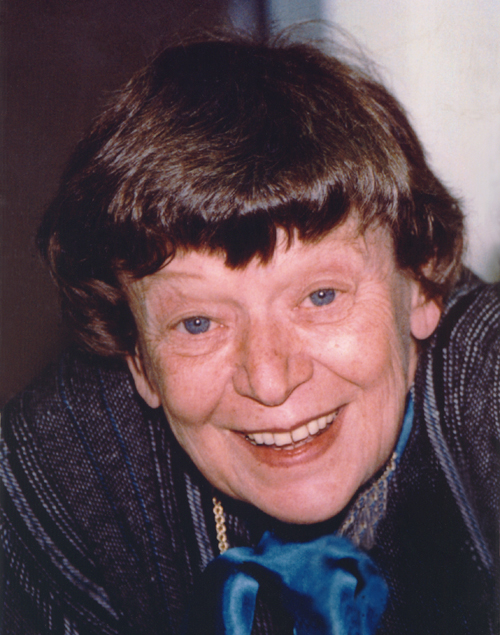
Ruth Mildred Ginn (Ursel) (1922-1999); Photo taken about 1995.
Read a little about the Ursel's in Canada in 'A Possible Story'.
He built their first home near Cyrville, east of Ottawa, from cinder blocks, in 1950/51 after returning from Seattle, WA, where they met. My mother working for TCA, the forerunner to Air Canada, as a passenger agent. They had gone to a party with other dates when they met but my dad, true to form, got her phone number anyway. Bill married Ruth Ursel in 1951 in Regina before returning to Seattle, where he was responsible for sending troops to Korea, and then on to Ottawa. My parents were devoted partners and clearly loved each other very much. I never heard them arguing, ever - although I remember my mother threatening divorce over a picture he took of her doing the laundry. I chose the best parents anyone could have. The property he bought in 1947 was expropriated in 1959 and he was informed that he could live there for an unknown time but that the house would probably be torn down. That was in 1959. The house is still there in 2024, on Pépin Court. The land is now occupied by the Innes Road bypass.
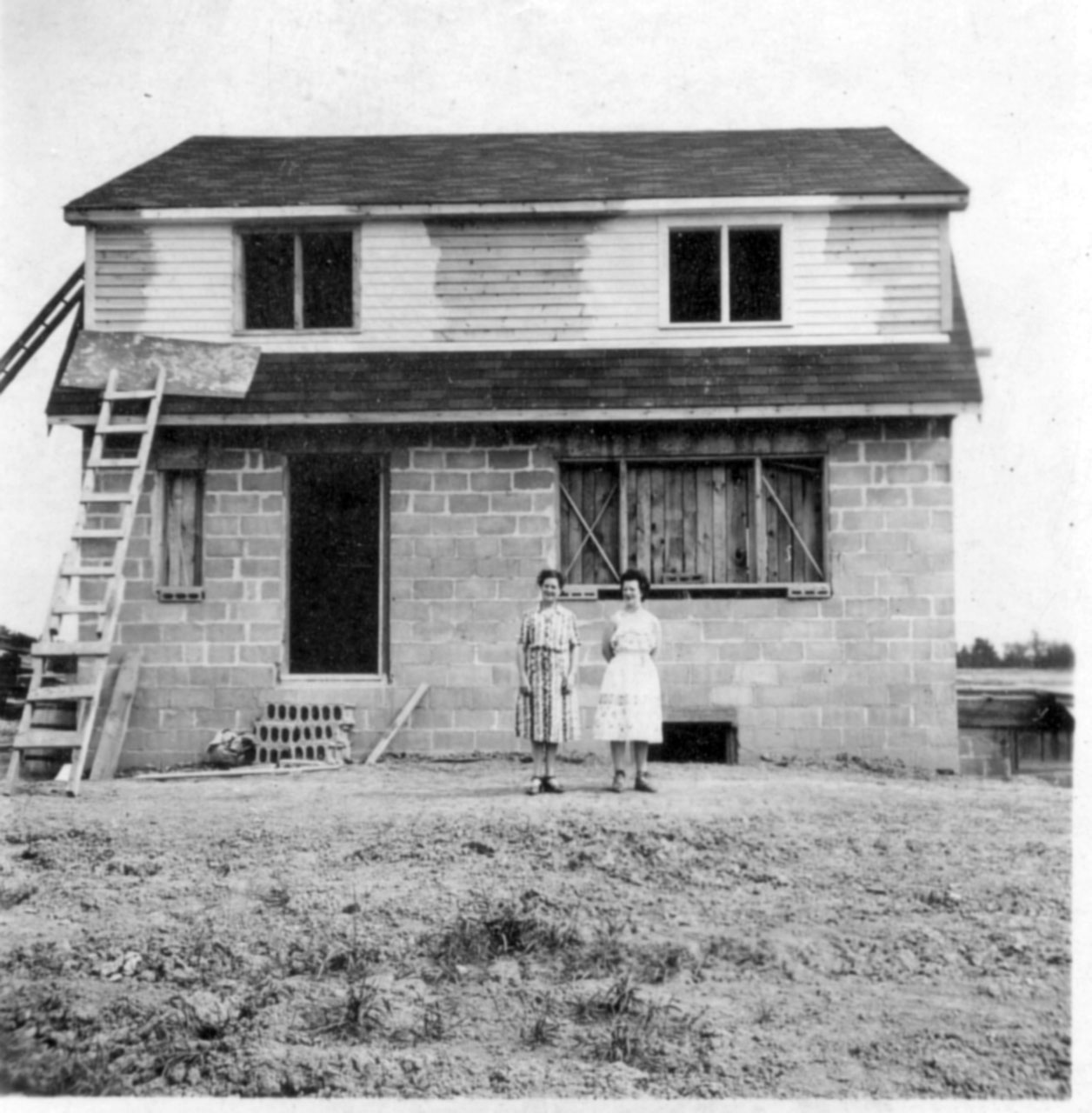
The house in Cyrville under construction in 1951. Standing in front are my Grandmother, Florence and my Aunt Alice.
Upon his retirement in 1960, after a stint running a small convenience store situated next to the Nelson Theatre on Rideau Street in Ottawa, he carried through with his lifelong love affair with the camera and he started what became Bill's Cameracraft, with my mother at his side. They were able to buy a modest home in southeast Ottawa and also start this business with the money he had received for the sale of the over 20 acres he had purchased near Cyrville. The federal government had expropriated the land for the new "greenbelt" around Ottawa.
He had decided to buy a business that was on the skids, known as "Clavier Film Service". People thought this was an insane move but he did it and he and my mother dedicated themselves to making it a success. The key to their success was a series of souvenir slides of sites around Ottawa. He went to the sites, took photographs and then they toiled night and day to produce sleeves of the slides that would be sold at the souvenir shop inside the Parliament Buildings. They did this for upwards of five years and it proved to be a major source of income for them.
Between 1960 and the time of his death in 1975, he and Ruth worked tirelessly to create the foundation of the company, Bill's Cameracraft Ltd. Ruth, and her boys, carried on this business which was sold in 1987 to Queen Street Camera, a Toronto company. Their sons - Barry, Ken and Doug grew up behind the counter and gradually assumed management responsibilities while learning that photography can be a truly rewarding pastime or occupation. In 1990, after Queen Street Camera went bust, the Ginn family returned to the photographic community in Ottawa with Ginn Photographic Co. which was in business until about 2007 when it was bought out by another Toronto company, Vistek.
In addition to my two brothers, Kenneth John Adam, born in 1954, and Douglas Stephen, born in 1958, I also have a half-sister, Dallas who was born in 1944. Ken, with his first wife Catherine M., has two children, Frederic George William, born in 1987 and Emily Andreann, born in 1990. Doug has one son, Stephen James with his first wife, France L., born in 1985. Dallas has two children, David and Sharyn from her marriage to John M..
Ken married his second wife, Ann-Marie E., in August, 2024, and Doug married his second wife, Colleen D. in September, 2022. There are no children from these marriages.
Recent additions: Frederic George William, son of Kenneth John Adam, who lives with his partner Annie C-D. near Wakefield, Quebec have three children together: Elizabeth, born 2015; Judith, born 2018 and Charlotte born 2021.
Ken's daughter, Emily, who is living with her partner Jacob P. south of Ottawa, recently had a daughter of their own, Abigail Grace born in 2022. They are expecting another daughter in April 2025. She will be Ken's fifth granddaughter.
I, myself, was born in 1952 and I have been married twice, once to Sandra E., which marriage lasted just over two years, and then to Rhonda B. and this marriage lasted nine years. I also had a third 'common law' relationship with Linda L., which lasted about eight years. I don't have any children.
Sadly Dorothy Bickerton, better known as Doris, passed away on Feb 25, 2021 at the Amica LTC home in Unionville, Ont at the age of 103. Doris was my Dad's sister and the last remaining member of her generation. Much like her mother, she was a very lovely woman, always cheerful and mentally quite alert until very near the end of her life. She had suffered a stroke a couple of years before and also, notably died during the COVID pandemic, so she wouldn't have been allowed visitors which must have made her life quite lonely.
Sources: 1: ancestry.co.uk; 2: https://en.wikipedia.org/wiki/Toponymic_surname
Family History
These documents are the most reliable information available about our own family history.
Ginn Family History (RootsMagic)
I've created this website, supplied by RootsMagic, to provide a touch point for a general look at our Ginn as well as Ursel genealogies. It is available to share as birthdates for living persons are not shown.
Ginn Genealogy Chart: Version to share (PDF format)
Ginn ancestry in a chart format. This version shows the known genealogy for our direct male line and related families. This version can be shared. Show only birth year for living family members. The links connect to Donna Bailey @ Geneanet database.
Ginn family of Hertfordshire: Ginn Hertfordshire blog by Dr Michael Taylor.
Dr Taylor chose our name for his one-name-study back in the 80s and we are very fortunate to have such a resource. Michael has spent an enormous amount of time and money in local archives and record offices throughout England, looking at primary resources and he tells the story of 'Ginns' through his blog. As he says, 'these are real people to me' and his biographies present about as much as can be known in an authoritative manner with reference to this data. He can read the 'Olde English' which is vital to translating what has been written down hundreds of years ago. This is the way genealogy should be done but most people just don't have the patience, knowledge or money to undertake such intense study. His material is widely quoted through other sites such as Ancestry, Wikitree, Geni and so on. Michael has also researched a number of other people that are not directly related and he includes many of his findings here. Note: The content written by Michael that has been copied on these other sites is often quoted without proper credit.
Also by Dr Michael Taylor: Ginn Genealogical Gleanings
Dr Taylor says "This blog is younger sister to my main blog and research on the Ginn family of Hertfordshire".
- Ginn Hertfordshire Blog Menu
This index shows the men who are our direct male ancestors but also links to other men that Michael has researched. - Updated Ginn Study by Dr Michael Taylor and Michael Ginn (about 1998) (PDF)
This is the original study and contains all the family sheets referenced in the Ginn Genealogy chart above.
Background or historical context
A day in the life in the 1600s
Sort of a snapshot of 'Ginn' life in late medieval rural Hertfordshire and how they lived.
About Mary Gill
John Gynn of Anstey married Mary Gill of Barkway on 4 Nov 1661/2. Gill is a well known and ancient family and can be traced back to the 13th century, at least.
Anstey, Aston and Hertfordshire Historical Notes
Historical notes and information about the location of the origin of our direct ancestors from William Ginn (b 1450, d 1520).
Berkhamsted
Speculation about the corelation between 'Gynn' name occurrences and the presence of King William I's fighting forces in the latter half of the 11th century. Locations of castles built in northeastern Hertfordshire seem to correspond to the presence of early Ginns in this area.
The Beginnings of the Ginn name
When I first started researching my 'Ginn' genealogy, one of the first things I did was to plot out a map of the occurrences of the name throughout England with data from the International Genealogical Index (IGI) which is widely considered to be a foundational resource in genealogy studies.
Finding evidence of earlier Ginns
Looking for ancestors before William Ginn (b 1450, d 1520).
Just as William is the progenitor of "most (virtually all) of the Ginn family descendants arising from Hertfordshire alive today", there is an earlier 'Gynn' man who was ancestor to all these families, or at least some of them. We have some evidence as to who he was, one Thomas Gynn, but to find this man based on BMD records is not possible because these records don't exist. In fact, as Dr Taylor has also said, "we are lucky to know as much as we do".
As well, we need to acknowledge 'The Black Death' erased much of the early population in the late 14th century. This was a seismic event and caused a certain amount of internal migration due to the shifting needs of the population and the necessity to adapt to a new world. So, an earlier ancestor may have migrated from another part of England, or he may have been resident close by, we have no way to know.
At the same time Hertfordshire Ginn's certainly did migrate to other regions as Dr Taylor has described in numerous posts.
As far as DNA testing is concerned, the DNA that might reveal any clues about our origins has been swirling around the North Sea for millenia. On the surface what we know is that people from Celtic, Germanic and Viking races comprise the bulk of the ancient British population. Money spent on a DNA test may be wasted, as it is unlikely to provide any further information, at least with respect to our English or European ancestors. Cultural knowledge is scant, nay - almost non-existent, however some insight may be in the pagan, especially Celtic, musical tradition that is thriving today throughout the world. A deeper dive reveals clues about the ancient past as may be found in the Similarities between Celtic Music and Middle Eastern Music.
I also caution reliance on genealogy sites such as FamilySearch, Ancestry, Wikitree and the like, their content cannot be taken as verbatim. In many cases the information is not taken from primary sources or might be done by someone with less than a full understanding of how to do it.
George Gynn & The Worshipful Company of Merchant Taylors
What we know about George Gynn, Merchant Taylor reveals that there are actually two George Gynn's, Merchant Taylors.
Gynn, Lavenham and the wool trade
No connection to these 'Gynns' has been established as yet however the historical village of Lavenham, Suffolk offers a valuable insight into what medieval England looked like.
Gynn Tymelyne
A snapshot of key historical events during the last 560 years, or so. Genealogy is not just about dates and names or who begat whom, it is also about connecting to history.
Sir John Perient (b 1350)
Sir John Perient is ancestor to Mary Gill who married John Ginn in 1661/2 in Anstey.
Sir John Perient of Digswell, Hertfordshire, also known as: "John Perient, Lord of Digswell" was born in 1350 in Gascony, France and is said to have emigrated to England with Edward, The Black Prince. His surname is also spelled 'Peryent'. He is the ancestor of Mary Gill who married John Ginn in 1661/2 and is a key figure in early Ginn famliy history. Note that when the year is not certain, it is often shown in this way. It means 1661 or 1662.
See also: GHB post by Dr Taylor about John Perient (d. 1432) who is the son of the above named Sir John Perient.
Summary of Ginn name occurrences
This is a collection of notes from a variety of sources that refer to 'Gyns' (or name variants) found. These people are mostly in the East of England but are also found elsewhere. The objective is to attempt to discover where our ancestors came from.
- Compare: Gyn/Gynes/Gyney Background Files in East of England (Before 1500)
A general overview of early occurrences of Gyn/Gynes/Gyney names in East of England counties.
This last set of documents provide some context and background to the development of England just after the Conquest. Many noble families from Normandy and Flanders were richly rewarded for their fealty and assistance to King William I.
An Heraldic Conundrum
Why does the coat of arms awarded to 'George
Gynn' bear similarities to the several coats of family 'Gyney' from Norfolk?
This family was descended from 'de Guînes' from Northern France. The elements in George's shield can also be seen in elements found in the 'blasons' from earlier French families or villages. Are these coincidences or plaigary - or was George passing along valuable family information?
French Migration to England after The Norman Conquest
The Lion Rampant in Arms and Heraldry
I am attempting to discover the origin of the 'argent, three lions rampant sable' design motif which appears on 'The Dering Roll', where we find 'William le Genne' using this design on his shield.
Guînes findings
This is a look at the 'de Guînes' family of Northern France. At present, there is no known connection to this family. However, there are certain historical parallels and chance occurrences of similar names that are intriguing.
Key Information sources
Primary sources are the only true sources for genealogical reference. Birth, Marriage Death records (aka BMD), census and other official government records are primary sources.
During the time period after the Conquest there were no primary records being kept, except for nobility. Church records weren't kept before the mid 16th century. Official state BMD records didn't start until the 19th century. Some earlier wills do provide valuable information.
Biographies and historical accounts by respected authors that have been properly vetted are key sources of information but they are not primary sources. Any data can give us a place to start looking and in many cases may end up being the only information we have. Again, we are fortunate that Dr. Michael Taylor has spent so much time verifying his sources and interpreting this information as accurately as can be done using currently available techniques. As time goes on, more and better information will become available.
The study of genealogy is expanding apace. More and more resources are becoming available and more and more people are undertaking family studies. This is a double edged sword because, although resources are available does not mean that people are using them properly. It is essential to corroborate and this is not easy. Eventually, the limit of known recorded source information will be reached.
A word of warning: One does not need any special license or permit to post, copy or transfer genealogical data. Therefore, much of the information that appears on genealogy sites has been gleaned from other genealogy sites, as if they were a primary source. They often copy information without quoting its source. These sites will often present as being authoritative but this is not the case. Often, the people doing their own personal research vary widely in skill and interpretative ability. So, some caution is always required.
Not everything that shows up is real or accurate. You will notice discrepancies quite often. Be careful quoting something that seems real but might end up biting you later on and wasting a lot of your time actually finding the truth.
The key is 'author'. In the case of primary records, the 'author' is the government authority which requires events to be registered in real time by some officially recognized individual and the records are always stored in a public records office.
Notes
The work on our Ginn genealogy has not been expanded much beyond our own family name, so there's still plenty of work to be done discovering allied family lines. These would be the ancestors of the wives of our own direct male ancestors. Their names are shown in red on the Ginn Genealogy chart above the wives names. Also in PDF format. The one exception would be Edward Gill and this is because he was from a landed gentry family so his genealogy has been documented.
One big gap is finding information about Harry Eccles, Florence Eccles's father. He was a soldier in the British Army and was sent to South Africa. Although I have found his attestation papers from his enlistment in 1887, any more information about him is difficult to find. I believe what I have been able to find out about Harry is accurate but it is not certain.
Throughout these pages, text in square brackets: [ ] are almost always notes made by me.
All of the other folders and files are accumulated data and findings in order to discover our real family history.
Church records often kept time based on the date of Easter. So, in cases where the exact year is unknown, the year will appear with two years with a hyphen or a forward slash between them, for example the year of the marriage of John Gynn to Mary Gill is shown as 1661/2. This means the year isn't clear and the marriage may have taken place in either year. It may also mean that different records show a date variance and it is not clear in which year the event took place.
The Genealogical Conundrum
Each of us has two parents. So, as one moves backwards in time each generation has twice as many ancestors. For example, we have four grandparents and eight great-grandparents. Each pair is a very precise connection between two people, one man and one woman.
If you look back ten generations, we would then have 1,024 ancestors; fifteen generations, 32,768 and twenty generations, 1,048,576 ancestors.
The problem is that as one moves back in time, the world's population is smaller and smaller. So, for example, if a typical generation is about 25 years, ten generations ago would be the late 18th century or about 1770. If your ancestry is English, the population of England in 1770 was estimated to be 7,428,000 including Wales. Fifteen generation ago, in about 1650, the population of England and Wales was estimated at 5,310,000 and twenty generations ago, in 1520, this number was 2,350,000.
Likely your ancestors came from small villages or towns with only a few hundred to maybe a few thousand residents, at most. So, whereas your calculated base of ancestors ten generations ago is 1,024, the area they came from might have had fewer residents. Everybody knew everybody and instances of multiple marriages between families was quite common. So, can you be related to every resident in a village? Yes, this is possible, albeit unlikely.
However as one moves back further in time the number of ancestor relations one needs to draw from will exceed the population of the area. Eventually you run out of available ancestors. So at this point, can you be related to everyone? Again, it is possible and that's why some people say that we are all cousins.
See this represented in a different way by looking at some genealogical math. That's right, starting from a single individual, if each generation has three children, and they all survived to have children, there would be about 3.5 BILLION descendants. And if each has four children, there would be a TRILLION descendants after 20 generations or the span of about five hundred years, give or take, if each generation was 25 years on average!
Finally, a note about DNA testing:
DNA says you're related to a Viking, a medieval German Jew or a 1700s enslaved African? What a genetic match really means, The Conversation, March 29, 2024
Abstract: Genealogical and genetic ancestors aren't the same thing. A DNA match, or a lack of one, may not tell you what you imagine it does about your family tree.
ABG Notes: This article amply describes the conundrum of genealogy and why DNA testing probably won't reveal too much about your ancestry.
In practice, each of our ancestors chose a mate from a pool of available mates, or a mate was chosen for them. This 'available' pool was comprised of individuals with similar characteristics. These include race, language, social status, age and so on. But the pool was not, in most cases, unlimited. Most couplings take place within this pool and very few occur outside of it. So, the range of open choices became 'relatively' limited and less than the available pool from ALL humans alive at the time. It is implicitly 'racial' because, historically, people tended to select a mate from other people most like themselves.
The result is a collection of certain traits and characteristics that are considered to be desirable or acceptable and are inherited by the next generation. So, if you're British, you're more likely to have inherited traits that are British; German is more likely to be similar to other Germans; Asian with Asian and so on. And this similarity is preserved over many generations. Going back into ancient times, a pool of available mates was quite limited. At the same time, many ancient peoples realized that in-breeding was a problem that limited the gene pool too much and therefore, couplings outside their group were often encouraged. That is why most Europeans alive today still have a small percentage of genes from now extinct Human ancestors such as Neanderthal.
Nonetheless, the possibility of being related to every Human that lived more than several hundred years ago is highly unlikely. In this way, the similarity of racial traits or characteristics is mostly preserved. With chance couplings taking place in random occurrences, it is possible for a small number of dissimilar traits to creep into a population. But, it is still a small number and does not alter the overall gene pool very much. It certainly won't say much about a single person's ancestral connections, except in a very general way. That is because we all have a similar set of such traits.
The result is that we share a set of common ancestral traits or characteristics that are representative of our own racial, cultural and social history. To know the specific links or connections, with a few exceptions, will not change that very much.